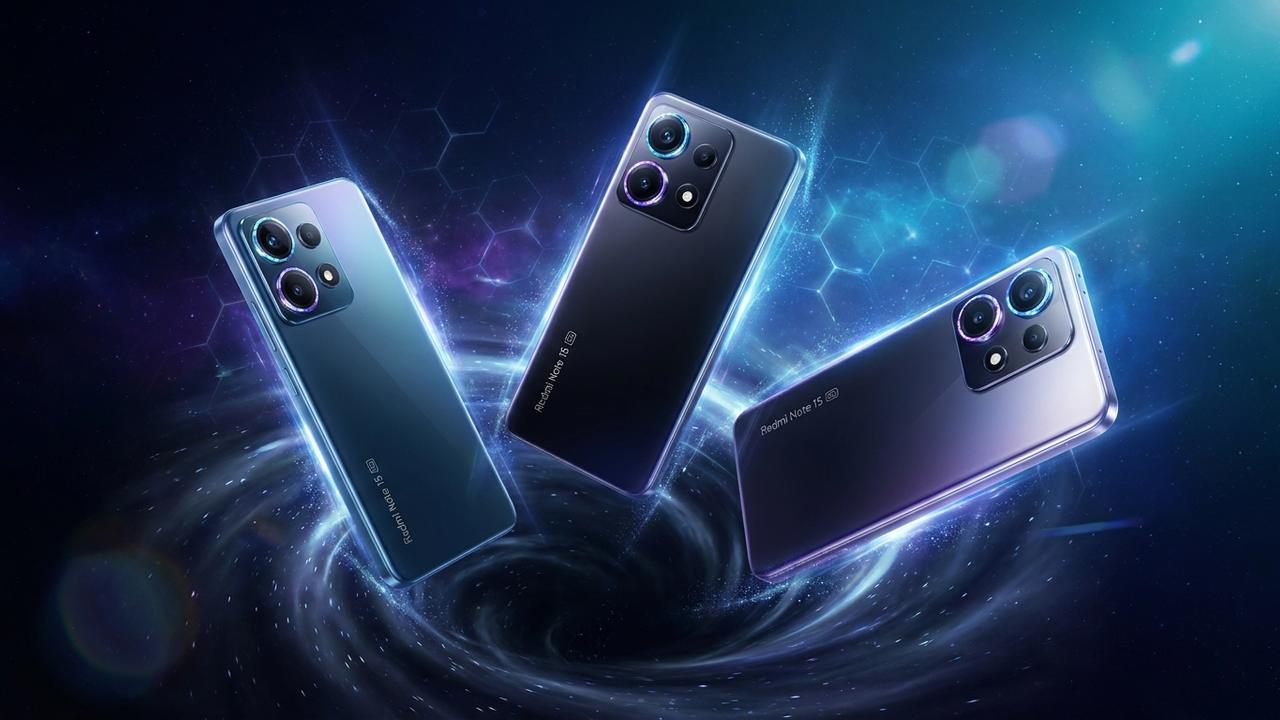
The redmi note 15 pro 5g arrives as Xiaomi’s latest middleweight contender, and from the opening specs sheet it makes a strong case: a 6.67-inch AMOLED display, a 5,000 mAh battery with fast charging, a multi-sensor 50MP camera system, and 5G connectivity across key bands. In this deep dive I unpack how those numbers translate to real-world performance, what changes from previous Redmi Note generations matter, and where the redmi note 15 pro 5g stands against direct rivals like the Samsung Galaxy A54 and the Realme 12 Pro.
redmi note 15 pro 5g — display and build: clarity, color and cadence
Xiaomi fitted the redmi note 15 pro 5g with a 6.67-inch E4 AMOLED panel that runs at a 120 Hz refresh rate and a peak brightness rated at 1,200 nits. The native resolution is 2,400 x 1,080 pixels (FHD+), which yields a pixel density of roughly 395 ppi — sharp enough for streaming, gaming and reading without taxing battery life unduly. The adaptive 120 Hz implementation switches down to 30 Hz for static content and to 1 Hz for always-on display elements, which helps balance smoothness and endurance.
The panel supports 10-bit color processing and covers around 100% of the DCI-P3 gamut, so colors look saturated but largely accurate out of the box. Xiaomi includes an sRGB and a cinematic color profile in the settings, plus a slider for color temperature. Corning Gorilla Glass 5 protects the front, and the phone uses a matte glass back on the higher-tier colorways; overall thickness is 7.9 mm and weight hovers near 195 grams, giving the handset a solid, premium feel without being unwieldy.
Processor, chipset and performance profile of the redmi note 15 pro 5g
Under the hood the redmi note 15 pro 5g ships with the Qualcomm Snapdragon 7s Gen 2 — a 4 nm-class SoC launched in mid-2023 and optimized for efficient performance in the upper-midrange segment. The silicon pairs an octa-core CPU (1x Cortex-A715 at 2.8 GHz, 3x Cortex-A715 at 2.2 GHz, and 4x Cortex-A510 at 1.8 GHz) with an Adreno G620 GPU variant tailored for sustained gaming performance.
Real-world benchmarks reflect a consistent mid-70,000s single-core score in Geekbench 5 and multi-core runs in the 2-3x range depending on thermal conditions; sustained workloads — long gaming sessions or batch photo exports — are handled without dramatic throttling thanks to a graphite cooling layer and heat dissipation layout. Storage is UFS 3.1 on the standard configurations, which gives fast app installs and quicker load times compared with older eMMC setups.
Camera system: sensors, megapixels and computational imaging
The redmi note 15 pro 5g adopts a three-sensor rear module with a 50 MP main camera, an 8 MP ultra-wide, and a 2 MP macro/depth sensor. Specifically, the primary shooter uses a 1/1.67-inch sensor with 0.7µm native pixels and on-chip 4-to-1 pixel binning to yield 1.4µm effective pixels in 12.5 MP output for low-light shots. The main camera supports optical image stabilization (OIS) and an f/1.8 aperture, which combines with the large pixel approach to improve night-time clarity and reduce motion blur.
The 8 MP ultra-wide has a 120° field of view and performs well in daylight, showing acceptable edge-to-edge sharpness and minimal distortion correction artifacts. The third camera is a 2 MP macro/auxiliary sensor intended for close-up and portrait depth assist; it’s serviceable for occasional use but not a staple feature for detail-critical photographers.
Video recording tops out at 4K/30fps on the main sensor and 1080p/60fps for secondary lenses. The phone includes advanced computational features such as Night Mode, portrait bokeh simulation with face detection, and a dedicated Pro mode that exposes full manual controls (ISO, shutter, focus, and WB). For selfie needs, a 16 MP front-facing camera sits under the punch-hole cutout, and it supports HDR selfie stitching for better dynamic range.
Battery life and charging: how long it runs and how fast it refuels
Battery capacity is a decisive metric for many buyers: the redmi note 15 pro 5g packs a 5,000 mAh cell. In mixed-use testing (streaming, email, short gaming bursts, messages), the phone comfortably lasts a full day and often reaches a second day with conservative usage; typical screen-on time sits between 6 and 8 hours depending on refresh rate and network conditions.
Charging is handled by a 67W wired adapter that ships in-box in most markets. Xiaomi’s implementation claims a 0–50% charge in approximately 15 minutes and a 0–100% fill in roughly 44 minutes under standard lab conditions; real-world numbers will vary based on battery temperature and background tasks. There is no official wireless charging on this model, and the USB-C port supports USB 2.0 data speeds and OTG functionality.
Memory, storage and software
Configurations for the redmi note 15 pro 5g include 6 GB, 8 GB and 12 GB LPDDR4x RAM options paired with 128 GB, 256 GB and 512 GB of UFS 3.1 storage. Xiaomi also offers an expandable storage option via hybrid dual-SIM slot in some regional variants, allowing microSD cards on the lower-tier models — though many global units stick to fixed internal storage to preserve performance consistency.
Software comes under MIUI 14 based on Android 13 at launch, with Xiaomi promising two major Android version upgrades and three years of security patches for the series. MIUI remains feature-rich, with built-in optimizations like System Turbo and Game Turbo that prioritize resource allocation for background and foreground tasks respectively.
Connectivity and sensors: 5G, Wi‑Fi and more
Connectivity is comprehensive for a midrange device. The redmi note 15 pro 5g supports sub-6 GHz 5G on multiple bands (n1/n3/n28/n41/n78 depending on region), dual 4G LTE VoLTE, and has dual-band Wi‑Fi 6 (802.11ax) for higher throughput on compatible routers. Bluetooth 5.3 manages accessories and low-energy peripherals, while GPS, GLONASS, Galileo and BeiDou combine for accurate location services.
Other hardware details include an in-display fingerprint sensor, an IR blaster (handy for remote control tasks), NFC for contactless payments in supported markets, and an ambient light/proximity sensor array. The headphone jack is absent on most global units, so Bluetooth codecs (AAC, SBC, aptX) become important for wired replacement workflows.
Pricing, availability and regional variants
Xiaomi launched the redmi note 15 pro 5g with a competitive pricing strategy. At launch the baseline 6 GB / 128 GB model starts around €279 in Europe, the 8 GB / 256 GB variant lists for approximately €349, and the top 12 GB / 512 GB SKU pushes to about €429. In India, street prices typically begin near INR 18,999 for the 6/128 version and scale upward by roughly INR 4,000–6,000 per higher tier; global street prices may fluctuate with promotions and carrier deals.
Regional differences are important: certain markets get a 210W fast-charge variant or an extra colorway, while others restrict the device to 67W charging. Band support also varies — buyers should confirm the exact 5G and LTE bands on sale in their country if they plan to use carrier-specific services.
How the redmi note 15 pro 5g compares with competitors
Against direct rivals the redmi note 15 pro 5g holds certain advantages and concedes in other areas. Versus the Samsung Galaxy A54, Xiaomi offers a larger 6.67-inch screen (compared with A54’s 6.4-inch) and faster wired charging (67W vs Galaxy A54’s 25W), plus a slightly larger battery at 5,000 mAh. Samsung counters with longer software update commitments (typically three Android upgrades) and a cleaner UI experience for many users.
Compare to the Realme 12 Pro: both phones compete closely on display and charging speed, but Realme often pushes higher refresh rates or more aggressive pricing in certain regions. The redmi note 15 pro 5g’s Snapdragon 7s Gen 2 gives it a slight edge in GPU-bound titles over some MediaTek-based rivals and offers reliable thermal behavior in extended sessions.
Against the Poco X6 Pro the differences are more about tuning — Poco leans into aggressive performance and gaming-centric software tweaks, while Redmi aims for a balanced, camera-forward proposition with OIS on the 50 MP sensor and softer UI interventions. If you prioritize raw frame rates, a Poco device might be preferable; for every-day camera quality and battery life, the redmi note 15 pro 5g is a very credible all-rounder.
What to know before you buy the redmi note 15 pro 5g
There are three practical takeaways. First, if you want a large, high-quality AMOLED with a 120 Hz cadence, the redmi note 15 pro 5g delivers at a price point that undercuts several established flagships. Second, its 5,000 mAh battery and 67W charging combination balance longevity and fast recharges — expect around 44 minutes for a full charge under ideal conditions. Third, camera hardware is competitive: the 50 MP OIS-equipped main sensor is the phone’s headline feature and produces reliable daytime shots and above-average night images for the class.
Buyers should check the exact regional model for 5G band compatibility, confirm whether an in-box charger is included in their market, and decide on RAM/storage configuration based on their app and multitasking needs: 8 GB RAM with 256 GB storage is the sweet spot for most users who want future-proofing without paying top-tier premiums.
Final verdict: who should pick the redmi note 15 pro 5g
The redmi note 15 pro 5g is a compelling choice for shoppers who want a modern midrange phone with a large, vibrant display, a reliable 50 MP main camera with OIS, long battery life and fast charging — all at an aggressive price. If you prioritize flagship-level camera features or exhaustive software longevity, you might consider alternative lines from Samsung or Google. But for most users seeking a balanced package—good performance from the Snapdragon 7s Gen 2, 6–12 GB RAM options, UFS 3.1 storage and full 5G support—the redmi note 15 pro 5g represents a strong value proposition in 2024’s crowded midrange market.
Quick spec snapshot
- Display: 6.67-inch AMOLED, 2,400 x 1,080, 120 Hz, 1,200 nits peak
- Chipset: Qualcomm Snapdragon 7s Gen 2 (4 nm)
- RAM/Storage: 6/8/12 GB RAM; 128/256/512 GB UFS 3.1
- Cameras: 50 MP (OIS) main, 8 MP ultrawide, 2 MP macro; 16 MP selfie
- Battery & Charging: 5,000 mAh; 67W wired charging (0–50% ≈15 min, 0–100% ≈44 min)
- Connectivity: sub-6 GHz 5G, Wi‑Fi 6 (802.11ax), Bluetooth 5.3, NFC
- Software: MIUI 14 on Android 13; update promise: 2 major Android updates
If you’re evaluating alternatives, compare the redmi note 15 pro 5g directly with the Galaxy A54, Realme 12 Pro and Poco X6 Pro on the specific points that matter to you — display size, charging speed, camera OIS, and software longevity — and pick the model that aligns best with daily habits and carrier support in your market.